Wednesday, 14 February 2018

No 174: A Valentine’s Day Poem?


If you read the last Notes from Piers the following will make sense. If you didn’t then it won’t.

Suffice to say, Richard Stilgoe is an absolute genius.  


THE END OF THE PIERS

Piers Clark is totally obsessed
With how Darth Vader, once undressed
And locked inside the Dark Star’s loo,
Produces weightless number two.
He wrote about it in his blog –
(An entry he called ‘Captain’s Log’.)

And then, when swimming just off Haiti
(Where Oxfam staff get far too matey)
Piers got a sudden inspiration –
“Super Critical Oxidation! –
That would turn Storm-trooper’s poop
Into pure and tasty soup;
Each time Darth Vader needs to go
We’ll just use S.C.W.O.

To prove this isn’t just a gag
I’ll have it ratified by TAG,
And then, with a small loan from REEF,
It’s my conclusion and belief
That this technology will give
Pure water to help people live!”

He flew back home to tell his staff
Who, trying bravely not to laugh,
Once his opening speech was done
Said “Piers – I think there may be one
Darth Vader fact you might have missed –
He doesn’t actually exist.
He isn’t real – there’s no such bloke,
So your technology’s a joke.”

Cried Piers, “Thank God the staff at Isle
Will always go the extra mile
To test and trial new ideas –
I need the judgment of my peers!”
(At this the staff polite laughs uttered –
They knew which side their bread was buttered).

Piers went on, “Of course I knew
Darth Vader doesn’t really poo,
And thanks to you the truth now dawns –
Instead we will use unicorns!”

The staff said “Poor Piers needs a change;
The Elon Musk Home for the Strange
Must be his future domicile.”
So now, retired, Piers lives in style
And smiles his medicated smile
While dreaming of his happy years
Desalinating all Earth’s tears
With Isle.
  
Richard Stilgoe
14th February 2018.

Saturday, 10 February 2018

No 173: Forget Starlight Express…


Earlier this month I spent a delightful evening at the top of The Gherkin with Richard Stilgoe. For readers not familiar with Richard, he was famous 3 decades ago for being a witty, charming, raconteur who frequently appeared on TV.1  Think of him as a 1970s Stephen Fry, only wittier. Best known for his humorous songs he wrote the lyrics to Andrew Lloyd Webbers ‘Starlight Express’ and was part of the writing team behind ‘Phantom of the Opera’. Lovely bloke that he is, he has donated a significant proportion of his royalties from these shows to various charities, including WaterAid. No wonder he was knighted in 2012.

I confess that I was not enjoying an exclusive 1-2-1 evening with Sir Richard. We were attending a WaterAid fundraiser. Part of the evenings fundraising activities included a silent auction, and a ‘personalized poem’ composed by Sir Richard was one of the coveted lots. Buoyed by the fact that my money would support WaterAid I bid feverishly and won. Next came the dilemma of deciding to whom I should dedicate my personalized poem.

Better men may have been tempted to dedicate such a unique gift to their wives. Or gift it to their children for future generations to enjoy. Not me. There was only ever one recipient I wanted my poem to focus on, and that is Isle. Isle is the specialist technical consultancy for which I have been Chairman since it formed in 2010. Today Isle employs 60 people, spread across 8 locations around the world. Our goal is simple: to help the water sector embrace and adopt new technology. I love Isle.

Forget Starlight Express, this could be the start of ‘Isle The Musical’

The fact that 48 hours previously I had been in Haiti with 7 of my Isle colleagues participating in the 5th annual 10km sea swim probably also shaped my decision. As has been recorded in these blogs previously, Isle has strong links with Haiti. This year the Isle team was raising money for Watering Minds, who provide clean water to local schools. $13k has been raised to date by the Isle team, which will ensure over 2600 children get clean water for the next year. Donations can still be made (https://fundraise.wateringminds.org/campaign/swim-for-haiti-2018-watering-minds/c157801). Highlights are here: https://drive.google.com/file/d/1niWoU1FHr-xnA--zk_XjTEHwTVT1Ifdt/view?usp=sharing.

Quite by chance this year I discovered the secret to having a successful swim. Once the initial horn is blown all the swimmers disperse very quickly and it can become a very long, very lonely and very gruelling event. This year, after about 2km I spotted another swimmer 20 yards ahead of me. It was a lady about my age, powering her way through the sea. I was immediately taken back 30 years to when I first met my wife at our local swimming club. I would chase her down the pool, trying to keep up. I locked into the same mind-set, imagined that she was my wife and that I was once more a hormonal 17 year old chasing the woman of my dreams through the water. The remaining miles just melted away and we crossed the finish line together, achieving personal bests of 2 hours and 54 minutes. Admittedly this is 30 minutes behind the winner, but he was a man called Diego and had the distinct advantage of having been born with both gills and fins.

When I shared with my new swimming partner, whom I had been chasing for the previous 2 hours, that my mental strategy had been to fantasize that she was my wife, she gave me a look that could only be interpreted as ‘Step back Wierdo. You are a creep’. Somehow the deeply romantic angle to my strategy, which had seemed so righteous at the time, got lost in the telling. My wife seemed equally unimpressed. Apparently chasing other women is always wrong. Always. Period.  

I may need to rethink to whom my poem is dedicated.


 1 For readers not familiar with The Gherkin it is an iconic London building, so named for its uncanny resemblance to a small pickled cucumber. Other London landmarks named after fish and chip accompianments include the Curry Sauce Interchange and Pickled Egg Circus.

Friday, 19 January 2018

No 172: How should a real Jedi Master treat their sewage?


Anyone who has seen the recent Star Wars movie can´t fail to have noticed the scene where the Rebel heroes are trapped in a sticky situation on the Death Star and conveniently escape through a man-entry sewer. I love the idea that, across the universe, sewage is captured via a capex-heavy water-based collection system.  I particularly like the idea that Darth Vader defecates: I imagine him going into a toilet cubicle, removing his mask and carefully hanging his long black cape on the back of the toilet door, being extra diligent to not to let it touch the floor (for obvious reasons, ….well, for anyone who has been in a male public toilet that is). I imagine him squatting down to business, just like every other human. Imperial Overlord or not, when nature calls, you answer.

Sewage treatment on the Death Star is, I assume, via a UASB1 (since conventional aeration-based systems would be prohibitively uneconomic due to the lack of oxygen in space). The biosolids generated must surely be treated via SCWO2 , as this would enable them to recover and reuse the precious water in the sludge. This would not be a cheap solution, but the one thing everyone knows about the Imperial Empire is they are not short of cash. Just look at how much they spend on their fancy suits.

For the Rebel Alliance however such gold plated treatment would be uneconomical. Fortunately the Alliance tend to be based on green lush planets where land availability is not an issue. The exception to this is obviously the ice planet Hoth (see Empire Strikes Back), but who wouldn’t want to live on Takodana (‘I have never seen so much green’ – Rey). Having space and sunshine creates treatment opportunities that the evil Empire simply cannot entertain on their dark and foreboding Death Star.  

Back in 2016 I had the honour of presenting a paper at the IWA conference on the conversion of wastewater to energy via the production of algae (see Note, No 154). I was not presenting work that I had done personally but rather I was a last minute stand-in for my good friend Frank Rogalla (Director of Innovation at Aqualia). There is nothing I enjoy more than stealing the limelight, but doing it legitimately for once only made it sweeter.  Earlier this week I met with Frank in Madrid for an update on the project.

Aqualia, as part of the ‘All-Gas’ project within the EU FP 7, have built a 2 hectare demonstration facility which can treat the sewage of 10,000 people. It is a thing of beauty. No odour and fantastically low power usage (0.15kWh/m3, compared to conventional nutrient removal methods which are typically 3 times this). It is actually a significant net energy generator – each ha (the surface of one football field) can provide fuel for 20 cars. Compared to conventional biofuels (eg Palm-oil-diesel, or sugarcane-ethanol) this is 4 times better. For more details please click: https://we.tl/pzcOTIakRC

Unlike other algae biofuel projects the AllGas team have kept the process gloriously simple, not complicating it with specialist algae species or the extraction of unique oils. Instead the AllGas project, as the name implies, simply grows whatever algae is naturally occurring, harvests it, and then converts it to biogas via a conventional anaerobic digester – while achieving free nutrient removal. The innate simplicity of the system is part of its beauty. No wonder it is the obvious treatment method of choice for the Rebel Alliance. Bearing in mind all the environmental and economic benefits you would think the Alliance would make a bigger noise about it but, apparently, in space no one can hear you scream (oops, wrong film).

Sadly Star Wars is not the only Hollywood movie to get confused about sanitation systems. The 1990s film ‘Robin Hood: Prince of Thieves’ has a scene near the start (where Kevin Costner first bonds with Morgan Freeman) where they escape from a medieval dungeon in an ancient Middle Eastern city via a Victorian sewer. It even has a manhole cover for crying out loud. I am tempted to conclude that powerful Hollywood moguls rate storytelling above the accurate representation of sanitation practices. Surely not?!

I feel the need to create a definitive list of water sector miss-representations in major films. When I finally get to meet Spielberg, Lucas and Nolan I will ensure they stand corrected. All suggestions welcomed. 


Note 1: UASB = Upflow Anerobic Sludge Blanket;
Note 2: SCWO – Super Critical Wet Oxidation)


Thursday, 16 November 2017

No 171: It was all going well until the calamari arrived…


The ancient city of Carthage, on the northern coast of Tunisia, has been a centre for trade and innovation for centuries. In Roman times it pioneered a unique water cooling method to enable chariots to run that little bit faster (I don’t know the detail but I assume it involved squirting water at the horses). Today it remains a city striving to be at the heart of innovation. ONAS is the national wastewater company, responsible for providing the 12million or so Tunisians with reliable sanitation. As with everywhere in the world, what the public want is to flush and forget. Our meeting today was to discuss innovative approaches and technologies which might ensure that ONAS continues to provide this important service. The format was quickly established: working through a translator I would introduce a technology; after a few minutes a vibrant conversation would commence, in a glorious mix of French, Arabic and English; eventually the ensuing hubbub would reach its natural climax and we would move onto the next technology on my list. Repeat until list complete.

As we worked our way down my list I was struck by how many challenges are common to wastewater utilities the world over (aeration costs, energy production). There are still some location specific issues but even these are merely isolated points in history. For example, back in the 1980s the challenge in the UK was how to remove the heavy metals from our sewage sludges. This is the same challenge Tunisia faces today. In the UK we solved the problem by systematically shutting down our manufacturing industry. The picky Tunisians seem to want a more forward thinking and sustainable solution.

Another reason for my visit to Tunisia was to engage with the TEAM initiative. TEAM stands for Training and Education in Africa and Middle East, and it involves the establishment of an training centre in Tunisia that could serve the wider region. Its formation will enable African operators to be trained locally, without the barriers of language, culture and expense which cloud normal international training programmes. The logic behind TEAM is quite simple: if the operators are better trained then more finance will flow into the African water sector (since investors will get a better return from better run assets). More investment means more people get improved sanitation services.  It is a beautiful model for institutional strengthening, and one that goes right to the heart of the issue.

The man behind TEAM is Fethi Merchi. Fethi is a quietly spoken man, but with the passion and vision to make TEAM a reality. Without Fethi TEAM would be nothing but a loose concept. I met Fethi for the first time yesterday, at a dinner in a local fish restaurant. All was going well until the calamari arrived. We had been talking, as one does, about our families and careers, finding common ground and shared experiences. It was at this point that Fethi commented that I looked ‘pretty good for my age’.

Initially I was flattered. I am acutely aware that the past few months have taken their toll. Having been on the road for 54 of the last 80 days my jet lag has reached such epic proportions that my body no longer knows when it should eat, sleep or empty its bowels (TMI?). I have vainly told myself that the wrinkles that recently appeared around my eyes are laughter lines, although deep down I know they are signs of wear and tear. Fathi’s comment that I looked young for my age was a welcome boost to my flagging ego.

Until it became apparent that he actually thought I was 62.

Sixty Two!

I am 48.

Somewhere I have lost a whole decade.

Upon realising his mistake there was an embarrassed silence, much akin to the moment one congratulates a large woman on being pregnant only to discover she is not. No matter what you say next you can’t recover.

Of course, it wouldn’t be quite so bad if Fethi, who already overflows with grace, charm and generosity didn’t look like he was in his late 30s.


He is 57. I am not jealous. 

Friday, 29 September 2017

No 170: Woolly thinking?


Ever agreed to something and then realised, just a little too late, that you shouldn’t have got involved?

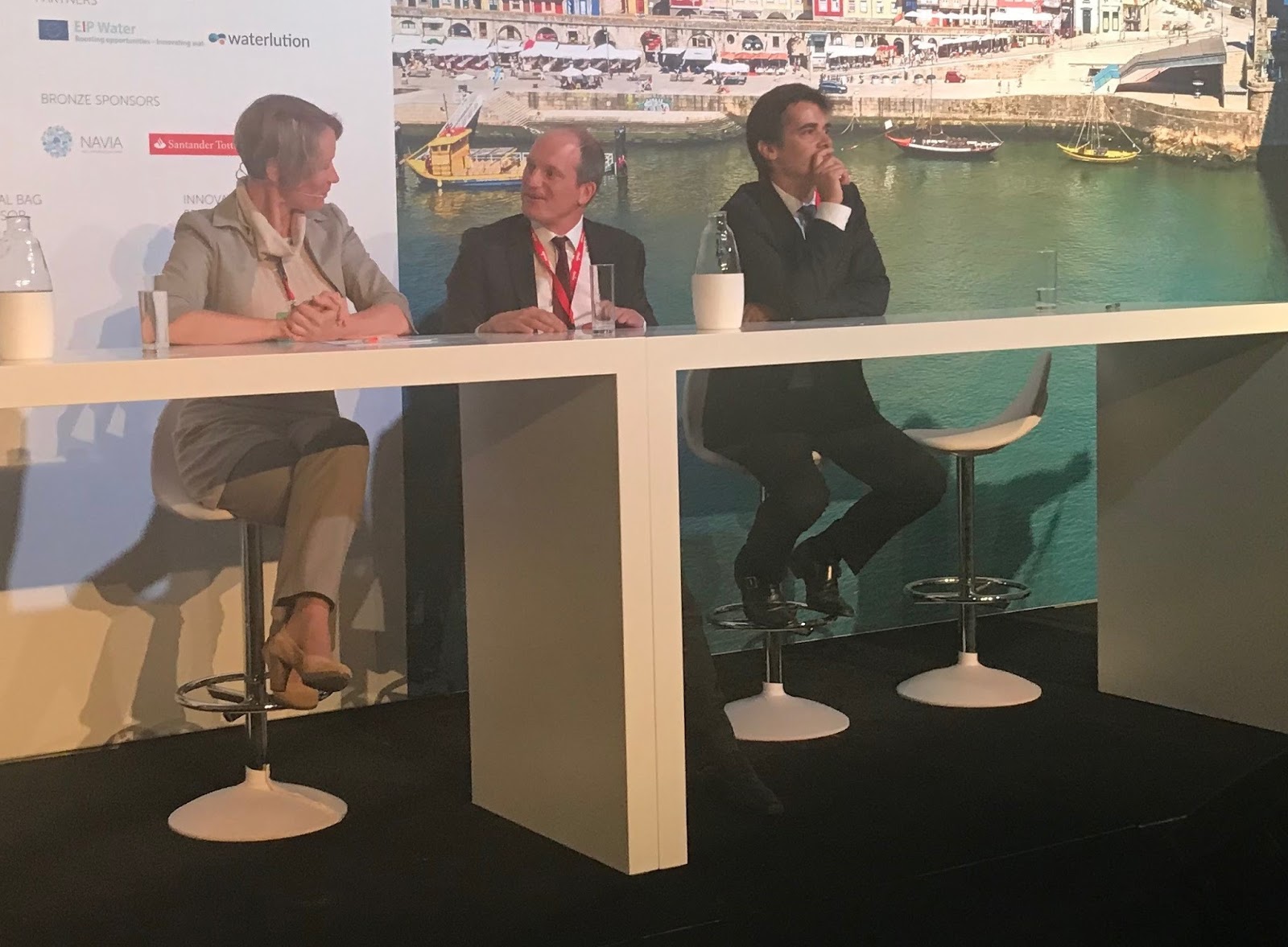
A few weeks ago I was asked by my (former) good friend Andrew Walker if I would participate in a social experiment at the EIP Water Conference in Porto. Andrew was the compere for the 2 day event, which is always good value, especially for people interested in new water-related innovations. I was intrigued by the invite so happily agreed. After all, I thought, Andrew hasn’t ever steered me wrong in the past. I also took comfort from the fact that Frederico Fernandes, President of Aguas do Porto and Associate Professor Uta Wehn from the Delft Institute were also involved. Frederico is the boss of the local water company. Uta is a wonderfully respected individual, working on innovative forms of ICT-based governance.  

The experiment was being organised by Maria Freitas, from the Portuguese National Laboratory for Civil Engineering. As we stepped onto the stage it was clear that neither Uta nor Frederico were any more informed than I as to what was about to transpire. Maria explained that she was going to undertake an experiment to showcase innovative thinking. Balls of wool were handed out to members of the audience and they were told to hold onto one end of the wool and to throw the ball as far as they could. It took a couple of minutes for the audience to embrace their inner child but once a few keen individuals got the idea it soon caught on. 5 minutes of chaos ensued as 25 brightly coloured balls of wool flew around the room in gay abandon.

Uta, Frederico and I sat on the stage wondering what our role was. it was only when a ball of wool smacked into my shiny bald head and ricocheted off in a new direction that I realised how exposed we were. (You will note from the attached photo that my chair for some unknown reason seemed to be a foot lower than the others. I sense this was all part of Andrew’s campaign to ridicule me).


Once the balls were fully unwound and the room resembled a web made from rainbows by spiders high on acid Maria called everyone to order. Having utterly disrupted the staid, professional air in the room, she now wanted everyone to work together to unravel the wool and recreate the balls. The look of shock and awe on the face of the audience was a wonder to behold. After the initial astonishment at the scale of the task had sunk in, some people stepped forward and started pitching ideas for how this could be achieved. Others worked together in little teams to unravel their own local bit of crochet. Some sat stony faced refusing to engage (see the lady in the bottom right hand corner of the attached photo).

It soon became apparent that the role Uta, Frederico and I were to play was to try and interpret the mayhem and draw some conclusions. It was, of course, a lovely metaphor for how good innovation works. I babbled inconclusively about how good innovation first needs a problem to solve and then it takes a team, working together, to unravel the mess. Not everyone joins in, but those that do usually get a sense of satisfaction.

Uta took it a step further, referring to the work that she has done as part of Ground Truth 2.0 (see gt20.eu), she commented that the exercise had shown how for good innovation to work the interactions between the parties need to be ‘honest’. Everyone needs to understand the conditions and the scope of the problem, only then they can mobilise around it. Too often, she said, we have solutions which are looking for problems to solve. Once you have the problem (‘I am covered in wool and need to be unknotted’) you can design a solution, which is often much more local in nature than one might immediately assume. She also noted, with a wry smile, that it was clear from where we sat on the podium that most of the people who threw the balls were male, whereas most of those who stepped forward to sort out the resulting mess were female. She is a clever lady that Uta.

Looking back, maybe I can forgive Andrew for walking me into this. I learnt something new.